9.4. Modern Approach: P-value
Example 1 (continue):
In
the coffee example,
 vs.
 ,
 ,
 .
Suppose
 , the p-value in this case is
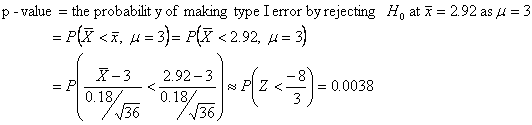

(the error we might make < (the
allowable error as reject  at )
The
error we might make by rejecting at is smaller than the allowable error.
Therefore, we reject .
Suppose
 ,
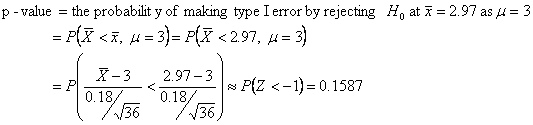

Since
the error we might make by rejecting at  is larger than
the
allowable error. Therefore, we can not reject .
Note: The conclusion based on the
p-value is the same as the one based on the previous
hypothesis
testing procedure.
Note: In the above example, let  be the sample
mean and
 . Then,
 .
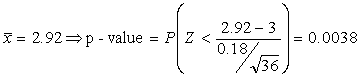
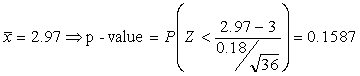
For example, as
General Case: as  and level of
significance

As  is known, let
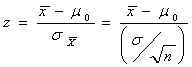 .
As is unknown,
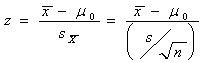 .
(I): 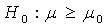 vs.

Then,

(II): 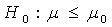 vs.

Then,

In (a) and (b), we then
compare p-value and the predetermined level of significance .
If 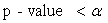 , then reject . Otherwise, we do not reject .
Example 3 (continue):
A sample with  provides a sample
mean of 36 and sample standard deviation of 12.
Consider the following
hypothesis test
 .
Find the p-value. What is
your conclusion as  ?
[solution:]
 .
Since
 ,
we
do not
reject .
JavaStatSoft:
Z
test:
Statistics
-> Tests -> One Sample -> Mean -> Z Test