The
normal probability density, also called the Gaussian density, might be the most
commonly
used probability density function in statistics.
Normal Probability Density Function:
A
random variable X taking values in  has the normal
probability density
has the normal
probability density
function
 if
if
 ,
,
where

Properties of
1. 
and

2.

3. X is a random variable with the normal density function. X is denoted by

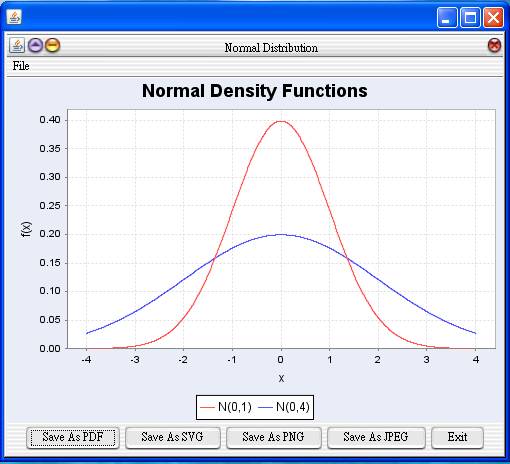
4. The standard deviation determine the width of the curve. The normal
density with
larger standard deviation would be more dispersed than
the one with smaller standard
deviation. In the following graph, two normal density
functions have the same means
but different standard
deviations, one is 1 (the solid line) and the other is 2 (the dotted line):
The normal density is symmetric with
respect to mean. That is,
 .
.
Also,
 .
.
The
probability of a normal random variable follows the empirical rule introduce
previously.
That
is,

i.e.,
the probability of X taking values within one standard deviation is about 0.68,
within two
standard
deviations about 0.95, and within three standard deviation about 1.
Standard
A
random variable Z, taking values in  has the standard
normal probability density
has the standard
normal probability density
function
 if
if
 ,
,
where
 .
.
Note: we denote Z as 
The
probability of Z taking values in
some interval can be found by the normal table.
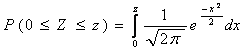
The probability of Z
taking values in [0,z],  can be obtained by the normal table. That is,
Computing Probabilities for any
Once the probability of
the standard normal random variable can be obtained, the probability of
any
normal random variable (not standard) can be found via the following important
rescaling:
