Example 3:
 representing the
number of heads as flipping a fair coin twice.
representing the
number of heads as flipping a fair coin twice.
 .
.
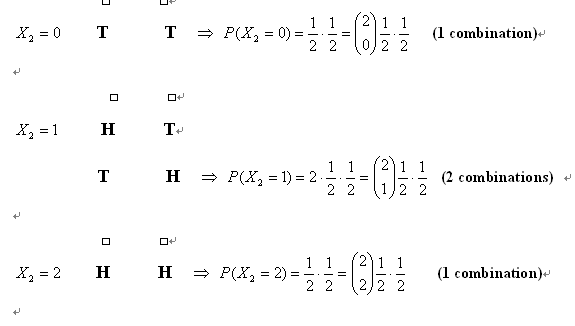

, 
 representing the
number of heads as flipping a fair coin 3 times.
representing the
number of heads as flipping a fair coin 3 times.

Therefore,

, 
 representing the
number of heads as flipping a fair coin n
times.
representing the
number of heads as flipping a fair coin n
times.
Then,
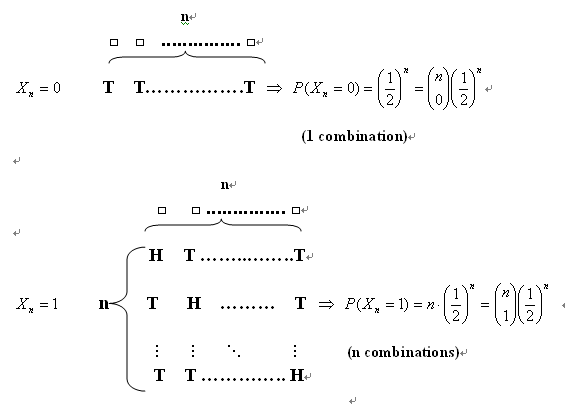
 (n combinations)


Note: the number of
combinations is equivalent to the number of ways as
drawing i balls (heads)
from n balls (n flips).
Example 4:
 representing the
number of successes over 3 trials.
representing the
number of successes over 3 trials.

Suppose
the probability of the success is  while the
probability of failure is
while the
probability of failure is  .
.
Then,
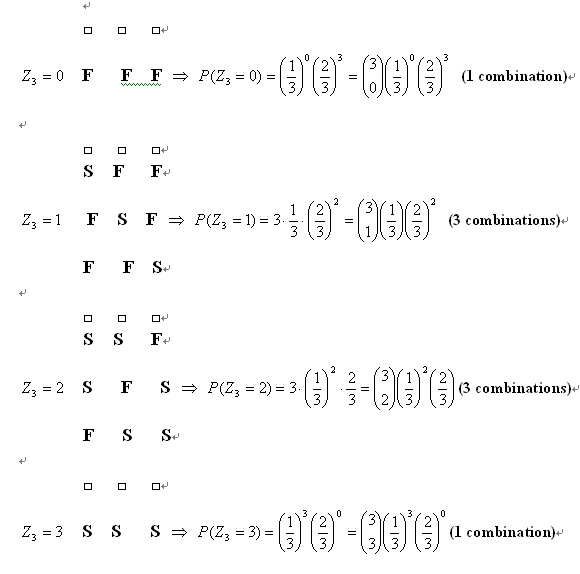

, 
 representing the
number of successes over n trials.
representing the
number of successes over n trials.
Then,
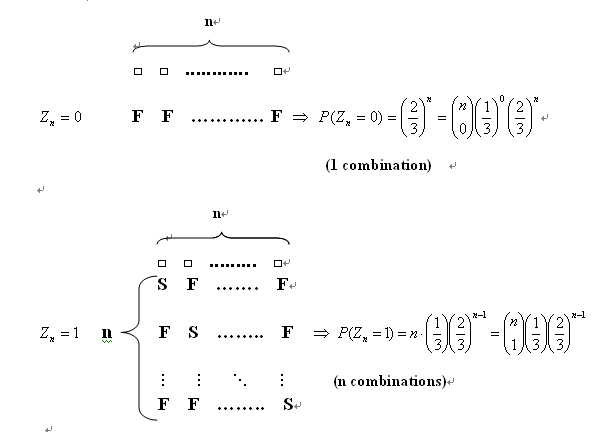

From
the above example, we readily describe the binomial experiment.
Properties of Binomial Experiment
X: representing the number
of successes over n independent identical trials.
The
probability of a success in a trial is p
while the probability of a failure is (1-p).
Binomail Probability Distribution:
Let X be the random variable representing
the number of successes of a Binomial experiment.
Then,
the probability distribution function for X
is
 .
.
Properties of Binomial Probability Distribution:
A
random variable X has the binomial probability distribution  with parameter
  ,
,
then

and
 .
.
JavaStatSoft:
Probability
density:
Statistics
-> Probability -> Probability Functions -> Probability Density
Function (PDF)
Probability
density:
Statistics
-> Probability -> Probability Functions -> Cumulative Distribution
Function (CDF)
Percentile
(or Quantile):
Statistics
-> Probability -> Probability Functions -> Percentile Function