10.2. Hypothesis Test about the Difference
Large Sample Case ( ):
):
General Case: as and level of significance 
As  are known, let
 .
.
As are unknown, let
 .
.
(I):  vs.
vs. 
Then,

In
addition,

(II):
 vs.
vs. 
Then,

In
addition,

(III):
 vs.
vs. 
Then,

In
addition,

Example 2:
Consider
the following results for two samples randomly taken from two populations.
|
|
Sample 1 |
Sample 2 |
|
Sample size |
64 |
49 |
|
Mean |
1150 |
921 |
|
Standard deviation |
90 |
65 |
Let  and
and  be the population
means.
be the population
means.
(a) For  , test
  using the
classical hypothesis test.
using the
classical hypothesis test.
(b) For  , please use p-value to test .
(c) For , please use the confidence interval method to test the
hypothesis
 .
.
[solution:]
(a)
 .
.
Then,

Therefore,
we reject  .
.
(b)
 .
.
Therefore,
we do not reject .
(c)
A
95% confidence interval for  is
is
 .
.
Since  , we reject .
Small Sample Case ( ):
):
Similar
to 10.1, two assumptions are made:
1.
Both populations have normal distribution.
2.
The variances of the populations are equal ( )
)
General Case: as and level of significance
 .
.
(I): vs.
Then,

In
addition,

(II):
vs.
Then,

In
addition,

(III):
vs.
Then,
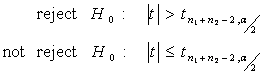
In
addition,

Example 3:
Consider
the following results for two samples randomly taken from two
normal populations with equal variance
|
|
Sample 1 |
Sample 2 |
|
Sample size |
10 |
12 |
|
Mean |
48 |
44 |
|
Standard deviation |
9 |
8 |
(a) Test  vs.
vs.  at
at using
using
the classical hypothesis
test.
(b)
Test  vs.
vs.  at using p-value.
(c) Test  vs.
vs.  at using
the confidence interval
method.
[solution:]
(a)  .
.
Then,

Thus,

Therefore,
we reject .
(b) 

Therefore,
we reject .
(c) A 95% confidence interval for  is
is

Since  , we do not reject .
JavaStatSoft:
Z
test:
Statistics
-> Tests -> Two Samples -> Means -> Z Test
T
test:
Statistics
-> Tests -> Two Samples -> Means -> T Test